Table of Contents
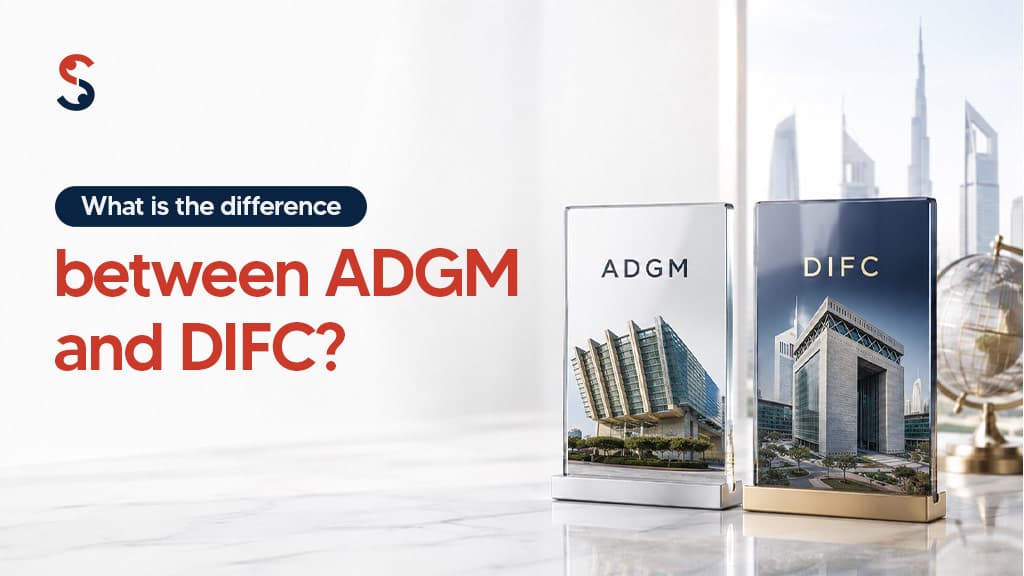
If you’re planning to set up a financial business in the UAE, chances are you’ve come across two names repeatedly. These two names are Abu Dhabi Global Market (ADGM) and Dubai International Financial Centre (DIFC).
At first glance, they seem almost identical. Both are internationally recognised financial free zones. Both operate under a common law framework. Both have a strong reputation among global investors.
However, while both are designed to support financial businesses, they have evolved in different directions over the years. And neither is better than the other. The right choice depends entirely on what your business needs today and where you see it growing tomorrow.
In this ADGM vs DIFC comparison, we’ll break down how these two financial centres differ. By the end of this guide, you’ll have a much clearer understanding of which jurisdiction aligns best with your business goals.
Established in 2015, Abu Dhabi Global Market (ADGM) is an international financial centre located on Al Maryah Island in Abu Dhabi. It was created to strengthen Abu Dhabi’s position as a global financial hub by offering businesses an internationally recognised and business-friendly regulatory environment.
One of ADGM’s defining features is its legal system. Unlike many financial jurisdictions, ADGM directly applies the English Common Law of England and Wales. This gives international businesses and investors a legal framework they’re already familiar with. ADGM also has its independent courts and the Financial Services Regulatory Authority (FSRA) that creates a high level of confidence for companies that operate across borders.
Over the years, ADGM has become particularly popular among businesses involved in:
What also sets ADGM apart is its forward-looking approach to innovation. It has consistently introduced frameworks that support sectors like fintech and virtual assets while maintaining strong regulatory oversight. This balance has made it an increasingly attractive destination for businesses looking to build future-ready financial operations.
Rather than trying to compete by replicating traditional financial centres, ADGM has focused on creating an ecosystem that encourages innovation, flexibility, and long-term growth.
Dubai International Financial Centre (DIFC) was founded in 2004 and is one of the leading financial centres in the Middle East region. It has spent more than two decades building a reputation as a trusted destination for multinational cooperations.
Like ADGM, DIFC operates as an independent financial free zone with its own legal framework and courts. It is regulated by the Dubai Financial Services Authority (DFSA) and follows a common law system through its own codified laws.
Many of the world’s leading banks, insurance companies, wealth management firms, investment houses, law firms, and consulting companies have established a presence here. This concentration of financial institutions creates an environment where businesses can collaborate and access global markets more easily.
DIFC is particularly well-suited for:
Another advantage is its location within Dubai, one of the world’s busiest commercial and financial hubs. Businesses here benefit from access to international talent and proximity to a large network of investors & clients.

ADGM and DIFC share the same vision of making the UAE a global financial hub. But over the years, they have evolved with different strengths. Each caters to different types of business and investment strategies.
Here’s a detailed ADGM vs DIFC comparison to help you understand where they differ and which one aligns better with your goals.
The most obvious difference between ADGM and DIFC is their location. ADGM is based on Al Maryah Island in Abu Dhabi, while DIFC is located in the heart of Dubai’s central business district.
DIFC sits in one of the region’s busiest commercial hubs. It is surrounded by multinational companies, global banks, and luxury hotels. So, if your business depends on meeting clients or collaborating with financial institutions, this environment can be a significant advantage.
ADGM offers a different experience. Abu Dhabi has steadily built its reputation as a centre for innovation. Businesses operating from ADGM often benefits from a more focused financial ecosystem, particularly in areas like asset management, venture capital, family offices, and emerging financial technologies.
In simple terms:
Both ADGM and DIFC operate independently of the UAE’s mainland civil law system. However, there’s an important distinction.
ADGM directly applies the English Common Law of England and Wales. This creates a legal framework that’s instantly familiar to many global businesses. DIFC also follows common law system but operates under its own international best practices and English legal principles.
For most businesses, this difference won’t affect day-to-day operations. However, companies that prioritise legal familiarity and sophisticated investment structures may evaluate these frameworks more closely before deciding where to establish their presence.
Every financial centre needs a regulator that ensures businesses operate transparently and comply with international standards.
Both regulators have built strong international reputations and maintain high compliance standards. Where they differ is in their regulatory focus.
The DFSA has decades of experience regulating traditional services such as banking, insurance, wealth management, and investment firms. On the other hand, the FSRA has gained recognition for developing progressive regulatory frameworks in areas such as fintech, digital assets, and financial innovation.
If your business operates in conventional financial services, either regulator can provide a strong foundation. For businesses working with newer financial technologies, ADGM’s regulatory approach has made it an increasingly attractive destination.
This is where the difference between ADGM and DIFC becomes much clearer. Although both support financial businesses, they have naturally developed different areas of expertise over time.
DIFC is best known for –
Its long-standing reputation and extensive corporate network make it a preferred destination for established financial institutions.
ADGM has become a preferred choice for –
Rather than competing directly with DIFC, ADGM has focused on creating an ecosystem that supports innovation and modern investment structures.
Both financial centres allow entrepreneurs to establish various types of entities. However, the options available may differ depending on your business activity.
DIFC offers suitable structures for operating companies and branches of foreign businesses. It’s particularly popular among businesses that require a physical presence and regular interactions with clients.
Meanwhile, ADGM has become especially well-known for structures such as Special Purpose Vehicles (SPV) and holding companies. These entities are widely used for investment holding, asset protection, and succession planning.
DIFC has developed one of the region’s strongest fintech ecosystems. That has resulted in bringing together startups, investors, and established financial institutions. This ecosystem offers significant opportunities for businesses looking to scale quickly while benefitting from an extensive corporate structure.
ADGM has taken a slightly different route. It has built a reputation for encouraging innovation through regulatory initiatives and clear frameworks for emerging technologies. This forward-looking approach has helped attract startups and technology-driven financial businesses exploring new business models.
Ultimately, the better ecosystem depends on what your business is trying to achieve. Companies seeking access to an extensive financial network may naturally gravitate towards DIFC, while those focused on innovation and newer financial technologies often find ADGM better aligned with their ambitions.
The cost of setting up a company in ADGM or DIFC varies depending on your business activity, license category, office requirements, visa allocation, and whether your business requires financial regulation.
As a general estimate, company formation in ADGM typically starts from around AED 15,000 to AED 25,000 for simpler business structures. Regulated entities and specialised licenses can cost significantly more. In comparison, DIFC company setup generally starts from around AED 20,000 to AED 40,000.
The exact cost depends on various factors, including:
For example, a holding company or Special Purpose Vehicle (SPV) will have very different setup costs compared to a regulated investment firm or wealth management company.
Generally speaking, ADGM is often considered more flexible for certain business structures. That is particularly true for SPVs, foundations, family offices, and some innovation-led businesses.
Whereas DIFC is home to many large financial institutions and premium office spaces. That means businesses operating there may have different commercial and compliance requirements.
So, instead of asking which one is cheaper, focus on which jurisdiction offers the best value for the type of business you are building. Choosing the right financial centre based on your business model will usually save far more time, money, and effort.
Like costs, the incorporation period depends on the type of business you’re establishing. A non-regulated holding company follows a much simpler process than a financial services firm that requires regulatory approvals.
Here’s a general comparison:

Overall, non-regulated businesses can often complete incorporation within 2 to 4 weeks, provided all documents are in order. Businesses requiring regulatory approval should plan for a longer timeline, as additional reviews are involved.
Both jurisdictions offer modern Grade A commercial infrastructure and provide businesses with access to world-class office facilities. However, the type of office you’ll need depends largely on your license and business activity.
For many regulated financial businesses, maintaining a physical office isn’t just a practical requirement. It forms part of the jurisdiction’s regulatory and operational framework. Businesses with simpler structures, such as SPVs, may have different requirements than firms actively providing regulated financial services.
The key takeaway is that office requirements shouldn’t be viewed as just another expense. They should be considered part of building a credible and compliant business presence within your chosen financial centre.
Both ADGM and DIFC are globally respected financial centres. But the ecosystem surrounding your business can influence everything from investor conversations to banking relationships.
DIFC has spent over two decades building one of the region’s largest financial ecosystems. It has a strong presence of international banks, investment firms, insurers, legal practices, and multinational corporations. This helps businesses to be a part of a well-established financial network.
ADGM has developed a different kind of strength. Its growing ecosystem has attracted venture capital firms, private equity investors, family offices, fintech startups, and businesses operating in emerging financial sectors. All this has made ADGM particularly attractive to innovation-led companies and investment-focused structures.
That doesn’t mean one jurisdiction automatically offers better access to banks or investors than the other. Financial institutions evaluate businesses based on several factors. That includes their business structure, compliance standards, and commercial viability. Your choice of jurisdiction is only one part of that equation.
There is no universal winner between ADGM and DIFC. The better choice depends entirely on your business objectives.
Choose DIFC if you:
Choose ADGM if you:
In many cases, founders assume they need the biggest financial hub, only to discover later that another jurisdiction is actually better suited to the way their business operates. Taking the time to evaluate your options upfront can save restructuring efforts in the future.
Choosing between ADGM and DIFC isn’t about finding the “better” financial centre. It’s about finding the one that best supports your business model and future ambitions. That’s why comparing free zone packages alone isn’t enough.
At Shuraa India, we help you look beyond package prices and marketing claims. Once we understand your business plans, we help you identify the jurisdiction that genuinely supports your growth, and not just the one that’s trending or sounds more prestigious.
Whether it’s ADGM, DIFC, or another UAE jurisdiction, we’ll help you make the right decision and handle the setup from start to finish.
Book Your Free Consultation Today.
Neither is universally better. The right choice depends on your business activity, regulatory requirements, and long-term objectives. Businesses involved in traditional financial services often prefer DIFC. Whereas, fintech companies, investment structures, family offices, and certain asset management firms may find ADGM more aligned with their needs.
Not necessarily. Setup costs vary depending on factors such as the business activity, license type, office requirements, visa allocation, and regulatory obligations. Instead of comparing only the initial setup cost, businesses should evaluate the overall value each jurisdiction offers for their specific business model.
Yes. Both ADGM and DIFC allow 100% foreign ownership. This enables international entrepreneurs and investors to establish businesses without the need for a local shareholder.
Yes. ADGM is regulated by the Financial Services Regulatory Authority (FSRA), while DIFC is regulated by the Dubai Financial Services Authority (DFSA). Both regulators oversee licensed financial activities and maintain internationally recognised compliance standards.
Yes, both ADGM and DIFC support a range of non-financial business activities, including consulting, professional services, holding companies, and family offices. However, the permitted activities vary between the two jurisdictions, so it’s important to choose the one that aligns with your business model.
The incorporation timeline depends on factors such as the license type, regulatory approvals, and document readiness. Simple company structures may be established relatively quickly, while regulated financial businesses usually require additional approvals that can extend the overall process.
Yes. Businesses incorporated in both ADGM and DIFC can apply for UAE residence visas. The eligibility of shareholders and employees is subject to applicable immigration regulations and visa quotas.
Yes, companies incorporated in both jurisdictions are eligible to apply for UAE corporate bank accounts. However, bank approval depends on factors such as your business activity, ownership structure, compliance documentation, and the bank’s internal due diligence process.
ADGM is widely recognised for its flexible framework for Special Purpose Vehicles (SPVs), foundations, and holding companies. It’s a popular choice for investment holding, asset protection, and succession planning. However, the right structure depends on your objectives and should be evaluated before incorporation.

About the author
Nityansh BhatiNityansh is a business content curator and UAE market advisor with expertise in company formation and corporate regulations in Dubai. He breaks down complex topics into clear and practical insights. His research-driven insights help entrepreneurs make confident and well-informed business decisions.
View all postsSpeak with Shuraa India for clear guidance on licensing, jurisdictions, visas, banking, and setup costs.