Table of Contents
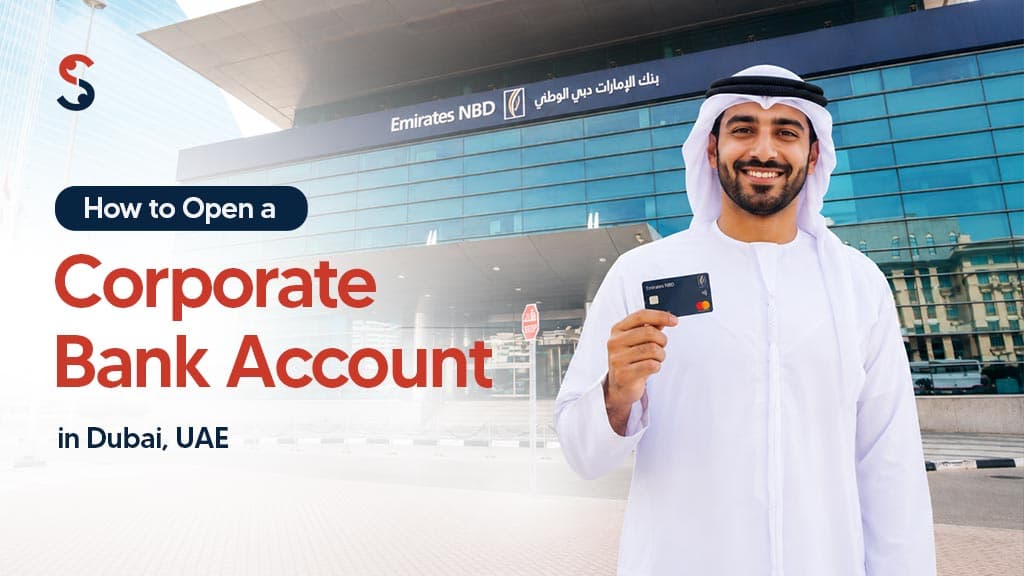
If you’ve just registered a mainland or free zone company in Dubai, opening a corporate bank account is your next non-negotiable step. UAE law doesn’t allow you to run business transactions through a personal account, and without a dedicated corporate account, you can’t pay VAT, process payroll through the Wage Protection System (WPS), or build the credibility that international partners and banks expect from a serious company.
We will walk you through eligibility, required documents, the step-by-step opening process, realistic timelines, 2026 compliance rules, common rejection triggers, and practical tips – everything you need to open a corporate bank account in Dubai without the guesswork.
A corporate bank account isn’t just a place to store revenue. In the UAE’s current regulatory environment, it’s the infrastructure your business runs on:
Eligibility depends on how your company is structured and registered.
Companies licensed by the Dubai Department of Economy and Tourism (DET) or another emirate’s economic department can open accounts with the full range of UAE banks. Onboarding for mainland LLCs and sole establishments is generally the most straightforward, since banks are most familiar with this structure.
Free zone entities can also bank with most UAE institutions, but some banks restrict certain free zones or business activities – particularly crypto, trading, and consultancy licenses that carry a higher compliance risk profile. It’s worth confirming your free zone’s existing banking relationships before you apply, since some free zones have pre-vetted partner banks that move faster.
Offshore companies (RAK ICC, JAFZA Offshore) typically cannot conduct business within the UAE and face tighter banking restrictions. Fewer banks accept offshore entities, and those that do usually require a higher minimum balance and stronger source-of-funds documentation.
A UAE branch of a foreign parent company needs additional documentation, including a parent company certificate of incorporation, audited financials, and a board resolution authorizing the branch to open and operate a local account.
While requirements vary slightly by bank, a “bank-ready” document set typically includes:
Banks increasingly ask for a documented “nature of business” explanation upfront rather than after the fact, preparing this in advance speeds up the compliance review considerably.

Not every bank serves every business activity. Some avoid trading or consultancy licenses; others specialize in SME or free zone banking. Compare minimum balance requirements, digital banking tools, and whether the bank has experience with your specific free zone or activity.
Assemble every document above before your first meeting. Incomplete files are the single most common reason applications stall.
Most banks now accept applications online or through a dedicated relationship manager, though final verification for signatories often still requires an in-person or video-call meeting.
The bank’s compliance team screens shareholders and directors against sanctions and PEP (Politically Exposed Persons) lists, verifies source of funds, and may request a short interview to confirm your business model matches your license.
Once approved, you’ll receive your IBAN, online banking credentials, and a debit/corporate card. Some banks place a temporary transaction cap on new accounts during an initial monitoring period.
| Company Type | Typical Timeline |
|---|---|
| Mainland LLC (Resident Shareholders, Straightforward Activity) | 3–10 business days |
| Free Zone Company (Standard Activity) | 1–3 weeks |
| Non-Resident Shareholders or Complex Structure | 3–6 weeks |
| Offshore or Branch Office | 4–8 weeks |
These are realistic ranges, not guarantees. A bank’s internal review backlog and how quickly you supply requested documents both affect the final timeline.
| Bank Type | Minimum Balance (AED) | Notes |
|---|---|---|
| Tier 1 Banks (Emirates NBD, FAB, ADCB) | AED 50,000–500,000 | Widest service range; often require a UAE residency visa |
| Mid-Tier and International Banks (Mashreq, HSBC) | AED 25,000–100,000 | Good for SMEs and cross-border trade |
| Digital/Neo-Banks (Wio Bank and Similar) | AED 0–25,000 | Faster onboarding and fewer physical visits |
Beyond the minimum balance, expect compliance review fees (roughly AED 1,000–5,000) and monthly penalties if your balance falls below the threshold. Always confirm current fee schedules directly with the bank, since they change periodically.
UAE banking compliance has tightened significantly. On 16 April 2026, the Central Bank of the UAE (CBUAE) issued updated AML/CFT guidance under Federal Decree-Law No. 10 of 2025, shifting Know Your Customer checks from a one-time onboarding step to continuous, risk-based monitoring. Key points relevant to your application:

Treat your bank application like a compliance submission, not paperwork. Assemble a complete, consistent document set, be ready to explain your source of funds clearly, and choose a bank with genuine experience in your sector rather than the first name that comes up in a search.
This is exactly where Shuraa India can help. Our team works directly with UAE banking partners across mainland, free zone, and offshore structures, and we handle document preparation, compliance documentation, and bank introductions for founders setting up from India. If you’re planning your company formation and corporate bank account together, get in touch with Shuraa India – we’ll match you with the right bank for your business activity and manage the process end to end.
Not always. Some banks accept non-resident shareholders, but most Tier 1 banks require at least one signatory to hold a UAE residency visa and Emirates ID for full account privileges.
Most banks work with free zone companies, but some restrict specific free zones or high-risk activities. Confirm your free zone’s existing bank relationships first.
Minimum balances typically range from AED 25,000 to AED 500,000 depending on the bank and account tier, with digital banks often requiring less.
The most common reasons are unclear source of funds, mismatched business activity and license, and incomplete or inconsistent documentation.
Some banks accept video-call KYC or embassy verification for non-resident signatories, but this isn’t universal – confirm with your chosen bank before assuming it’s an option.

About the author
Ritish SharmaRitish Sharma is a professional writer and UAE business advisor with expertise in corporate regulations and company setup. He helps Indian entrepreneurs understand and navigate the UAE’s dynamic business landscape, simplifying complex legal and business concepts. With actionable insights and practical guidance, Ritish empowers Indian businesses to establish, grow, and succeed in the UAE market confidently.
View all postsSpeak with Shuraa India for clear guidance on licensing, jurisdictions, visas, banking, and setup costs.