Table of Contents
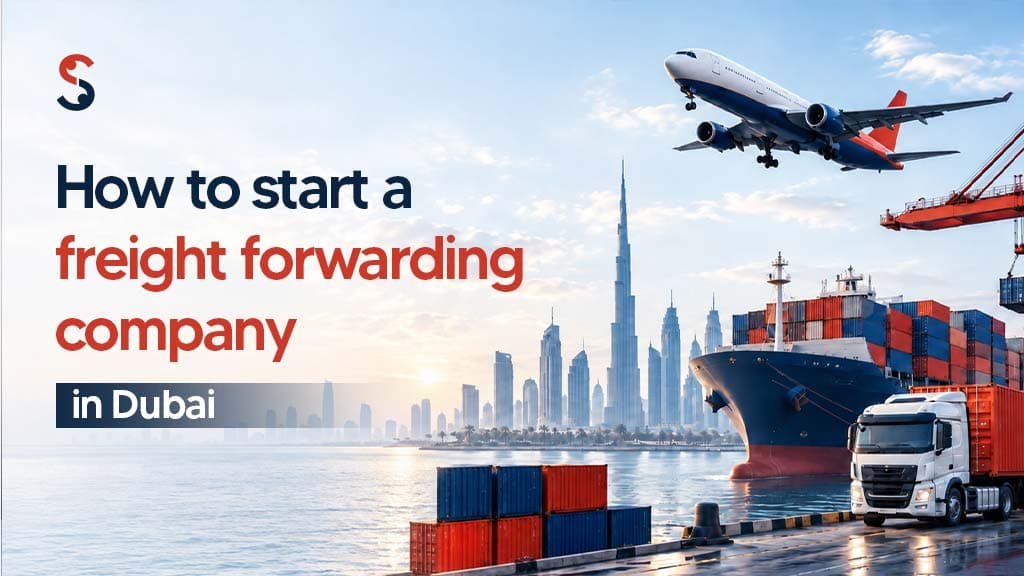
Dubai sits between Asia, Africa and Europe, and a huge share of the cargo moving between those regions passes through its ports, airports and road corridors. Someone has to coordinate all of it: the bookings, the paperwork, the customs clearance and the carriers. That someone is a freight forwarder.
If you are thinking about how to start a freight forwarding company in Dubai, the entry point is more accessible than many people expect. You can begin asset-light, with a licence, a modest office and the right customs registrations, and add warehousing or transport later. This guide covers the licence you need, mainland versus free zone, costs, and the steps to launch, so you know what to expect before you commit.
Quick answer: To start a freight forwarding company in Dubai, choose between mainland and a free zone, obtain a trade licence with a freight forwarding activity, secure an office, register with Dubai Customs, and open a corporate bank account. Most forwarding-only setups cost roughly AED 20,000 to AED 50,000 in the first year and take around two to three weeks, depending on the jurisdiction and the activities you add.
A freight forwarder is the intermediary between shippers (importers and exporters) and carriers such as airlines, shipping lines and trucking companies. You usually do not own the aircraft or vessels. Instead, you:
This is why a freight forwarding business in Dubai can start lean. Your product is expertise, relationships and reliability, not heavy assets.
Why Dubai is a Strong Base for a Freight Forwarding Business
Every freight forwarding company needs a trade licence with a freight forwarding activity. On the mainland, the licence is issued by the Department of Economy and Tourism (DET). In a free zone, it is issued by the zone authority, such as IFZA, JAFZA, DMCC, DAFZA or Dubai South. Activity names differ between authorities, so confirm the exact wording for air, sea or land forwarding before you apply.
A freight forwarding licence covers arranging shipments and documentation. A logistics licence is broader and may include warehousing, distribution and third-party logistics (3PL). That brings extra approvals, such as a warehouse permit from Dubai Municipality and, if you own vehicles, registration with the Roads and Transport Authority (RTA). Many founders start with forwarding only and expand once revenue is steady.
Your trade licence lets you operate, but it does not by itself let you clear goods. You also need a Dubai Customs registration (customs code). If you file declarations for clients, you need the relevant customs clearance approval or a partnership with a licensed clearing agent. Build this into your timeline from day one.
Neither option is automatically better. It depends on who your clients are and how your cargo moves.
| Factor | Mainland (DET) | Free Zone (JAFZA, DAFZA, Dubai South, etc.) |
| Ownership | Up to 100% for most activities | 100% foreign ownership |
| UAE market access | Direct access to local clients and contracts | Needs a permit or dual licence to work on the mainland |
| Office | Physical office with an Ejari tenancy contract | Flexi-desk, office or warehouse in the zone |
| Port and customs access | Standard Dubai Customs process | Often smoother near ports and airports, especially JAFZA |
| Best suited to | Mixed local and cross-border clients | Import, export and re-export focused models |
| Indicative licence cost | Around AED 20,000 to 35,000 | Around AED 12,000 to 50,000, depending on zone and facility |

Here’s a simple step-by-step process to start your freight forwarding company in Dubai:
Decide whether you will focus on air, sea, road or multimodal freight, whether you handle imports, exports or both, and which industries you will serve, such as e-commerce, machinery or FMCG. A clear niche helps you choose the right activity and win your first clients.
Use the comparison above. If most clients are UAE-based businesses, mainland is usually the practical route. If you focus on transit cargo and want proximity to a port or airport, a free zone can make sense.
Pick the precise freight forwarding activity you need, and add customs clearance if you plan to lodge declarations. Choose a trade name that follows Dubai naming rules and avoids restricted terms.
Submit passport copies, photos, your proposed name and activity details, and pay the fees. On the mainland, initial approval comes first, followed by the tenancy contract and final licence issuance.
Mainland companies need a registered Ejari tenancy contract. Free zones bundle a desk or office into the licence package. Freight forwarding does not require a warehouse unless you plan to store goods.
Apply for your customs code and any approvals needed to process clearance for clients. Some registrations may require a deposit or guarantee.
Open a corporate bank account, apply for your establishment card and residence visas, and arrange liability and cargo insurance. Banks can take longer than the licence itself, so start early.
Most forwarding-only setups in Dubai cost roughly AED 20,000 to AED 50,000 in the first year. That covers your trade licence, office space, customs registration, and visa and establishment card fees. Where you land in that range depends mostly on your jurisdiction and how many visas you need.
| Cost Item | Indicative Range (AED) | Notes |
| Trade licence and activity registration | 12,000 to 35,000 | Lower at some free zones, higher for mainland or premium zones |
| Office, Ejari or flexi-desk | 5,000 to 15,000+ | Depends on size and location |
| Customs code registration | A few thousand | Deposits or guarantees may apply |
| Establishment card and visa | Varies | Depends on number of visas |
| Warehouse permit (only if needed) | 8,000 to 15,000 | Mainland warehouse permit range; free zones differ |
Budget beyond government fees, too: cargo liability insurance, freight management software, marketing, and working capital. Carriers and agents often expect payment before your clients pay you.
A freight forwarding company in Dubai must comply with the UAE’s applicable tax and business regulations. The main areas to consider include corporate tax, VAT, accounting, and record-keeping.
Shuraa India supports Indian entrepreneurs and businesses setting up in the UAE. Our consultants help you compare mainland and free zone options, confirm the right freight forwarding activity, and manage licensing, customs registration, visas and banking support so you can focus on winning clients.
Yes. You need a trade licence with a freight forwarding activity from DET or a free zone authority, plus a Dubai Customs registration if you handle clearance.
Yes. Free zones allow 100% foreign ownership, and most mainland activities now allow it too. Confirm the rules for your specific activity.
Typically, around one to three weeks for the licence. Customs registration and bank account opening can add time.
Not for a pure forwarding model. You need a warehouse permit only if you store goods.
Roughly AED 12,000 to 50,000 for the licence depending on jurisdiction, with total first-year costs varying by office, visas and customs needs.

About the author
Ritish SharmaRitish Sharma is a professional writer and UAE business advisor with expertise in corporate regulations and company setup. He helps Indian entrepreneurs understand and navigate the UAE’s dynamic business landscape, simplifying complex legal and business concepts. With actionable insights and practical guidance, Ritish empowers Indian businesses to establish, grow, and succeed in the UAE market confidently.
View all postsSpeak with Shuraa India for clear guidance on licensing, jurisdictions, visas, banking, and setup costs.