Table of Contents
If you are planning to move to the UAE for work or business or you are an employer based in India sponsoring staff for UAE visas, there is an important immigration update you cannot afford to miss.
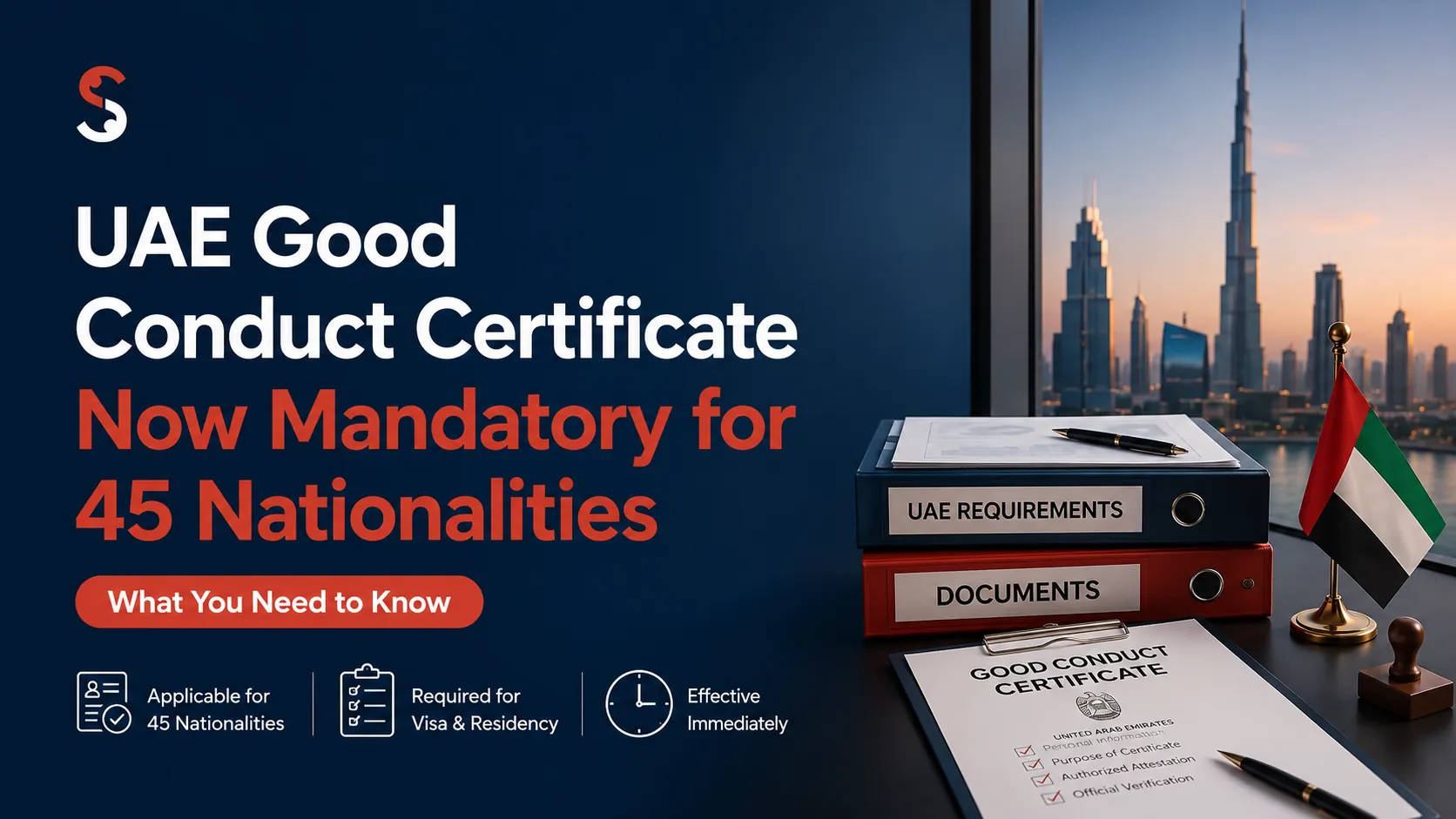
The UAE’s Federal Authority for Identity, Citizenship, Customs & Port Security (ICP) has officially made the Good Conduct Certificate (also known as a Police Clearance Certificate or PCC) a mandatory requirement for visa applications from 45 specified nationalities. The rollout began on 16 June 2026 and will be implemented in three phases through November 2026.
But let’s first understand:
A Good Conduct Certificate, commonly referred to as a Police Clearance Certificate (PCC), is an official government document that confirms an individual has no criminal record in their home country. It is issued by the relevant police or home affairs authority and is used as a background verification tool in immigration processes.
For UAE visa applications, this certificate must be:
The UAE has consistently strengthened its immigration compliance framework to maintain its status as one of the world’s safest and most business-friendly destinations. This update is in line with ICP’s ongoing efforts to enhance security screening, streamline residency visa processing, and ensure that all incoming residents meet legal and safety standards.
The phased rollout across three dates – June, August, and November 2026, gives nationalities and their employers adequate time to prepare and gather the required documentation.

The ICP circular, circulated via free zone authorities including ANC Free Zone, outlines three phases of implementation:
| Phase | Effective Date | Nationalities Affected |
| Phase 1 | 16 June 2026 | Cameroon, Algeria, Egypt, Ethiopia, Cuba, Bhutan, Bulgaria, Mexico, Afghanistan, Nepal, Iraq, Pakistan, India, Mozambique, Ghana, Lebanon, Somalia, Gambia, Lithuania, Tonga, Senegal, Syria, Morocco (23 countries) |
| Phase 2 | 15 August 2026 | Bangladesh, Colombia, Sudan, Tunisia, Zimbabwe, Nigeria, Cyprus, Albania, Mauritius, Fiji, Philippines (11 countries) |
| Phase 3 | 15 November 2026 | Mauritania, Rwanda, South Africa, Iran, Serbia, Belarus, Georgia, Nicaragua, Slovenia, Seychelles, China (11 countries) |
Note: The UAE Embassy or Consulate attestation country may differ from the applicant’s nationality. For example, Bhutan nationals must get their PCC attested from the UAE Embassy in India, and Gambia nationals from the UAE Embassy in Senegal. Always verify the designated attestation country for your nationality.
India appears on the Phase 1 list, meaning Indian nationals applying for new UAE visas from 16 June 2026 onwards are required to submit a Good Conduct Certificate as part of their visa application.
If you are an Indian national currently in the UAE on an existing residence permit and wish to renew or change your visa, the requirement may be applied differently – typically, a UAE-issued Police Clearance Certificate from MOI (Ministry of Interior) may be accepted instead of a home country PCC.
If you are applying for a UAE visa from India, you will need to:
One of the most critical and commonly misunderstood parts of this process is the attestation order. The correct sequence is:
If you translate the document after it has already been attested, the translation will not be covered by the attestation seal and ICP will reject the application. This is a procedural error that causes significant delays, plan ahead and follow the steps in the correct order.
Based on current guidance, this requirement applies to new UAE visa or entry permit applications. Expats who are already in the UAE and moving jobs within the country are generally not required to submit a fresh home country PCC, a UAE-issued Good Conduct Certificate from the Ministry of Interior or Dubai Police may suffice in such cases.
However, rules can vary by free zone, emirate, and employer. Always check with your PRO, free zone authority, or a registered business setup consultant before proceeding.
If you are an Indian entrepreneur planning to establish a company in the UAE, whether in a free zone, on the mainland, or offshore, this update is directly relevant to your visa application as well. India’s inclusion in Phase 1 means this is now an immediate requirement, not a future consideration.
At Shuraa India, we have been helping Indian nationals through UAE immigration and business licensing requirements for over two decades. Our team in India keeps up with every ICP update, free zone circular, and GDRFA directive so that you don’t have to.
Whether you need guidance on collecting your PCC, getting it attested, or handling the full UAE visa application alongside your business setup, we are here to make the process straightforward.

About the author
Ritish SharmaRitish Sharma is a professional writer and UAE business advisor with expertise in corporate regulations and company setup. He helps Indian entrepreneurs understand and navigate the UAE’s dynamic business landscape, simplifying complex legal and business concepts. With actionable insights and practical guidance, Ritish empowers Indian businesses to establish, grow, and succeed in the UAE market confidently.
View all postsSpeak with Shuraa India for clear guidance on licensing, jurisdictions, visas, banking, and setup costs.