
Table of Contents
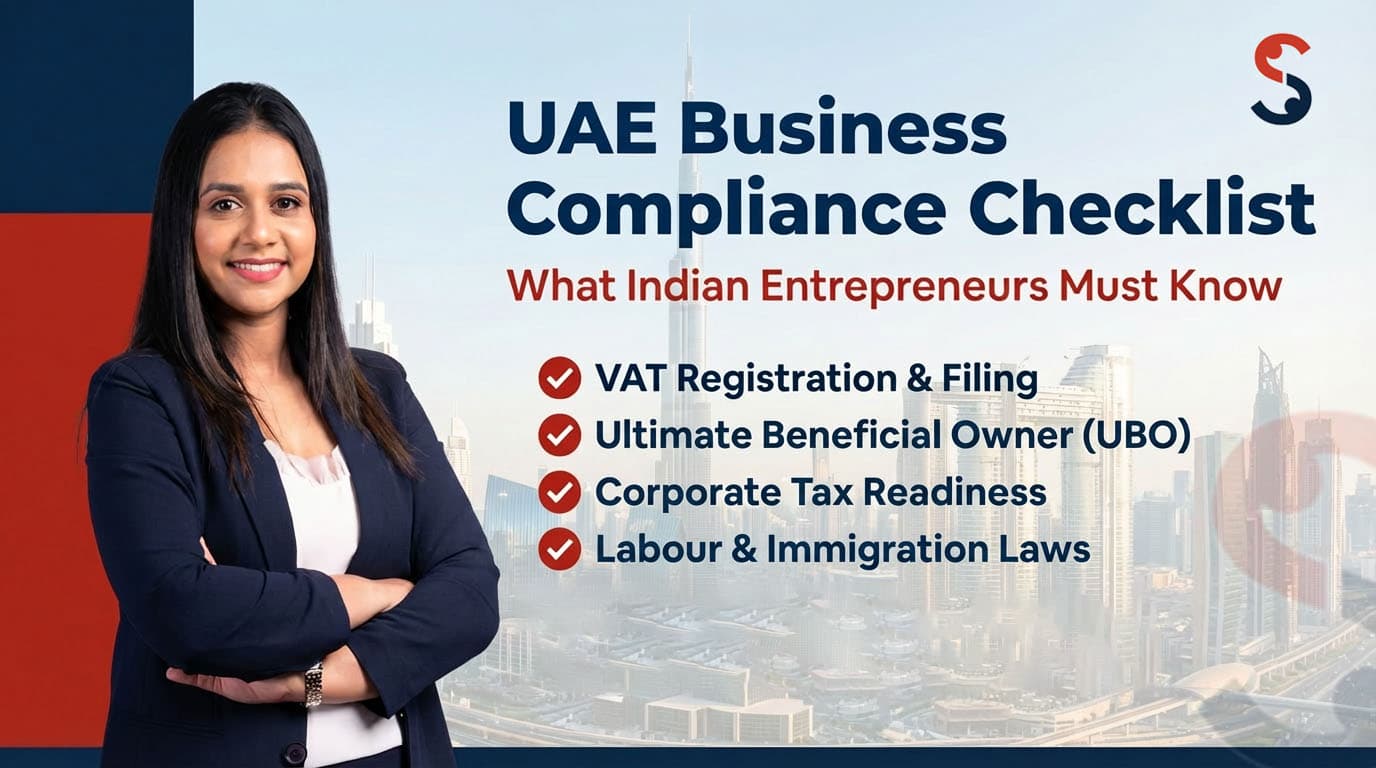
Moving to the UAE is a dream for many Indian entrepreneurs, and for good reason, it’s close to home, tax-friendly, and a gateway to the rest of the world. But here’s the reality: the UAE’s business world has grown up fast. The days of “set it and forget it” paperwork are gone. In 2026, staying on the right side of the law is just as important as finding your first customer. This is where a UAE business compliance checklist becomes extremely useful, especially if you’re new to the local regulations.
For an Indian founder used to the GST and MCA systems back home, the UAE’s rules might look simpler on the surface, but they have their own set of unique “must-dos” that can catch you off guard if you aren’t careful.
You need to follow visa and immigration rules, register for VAT or Corporate Tax if applicable, maintain proper accounts, and renew licenses and visas on time. Delayed renewals, overlooked tax registrations, or mixing personal and business transactions are common mistakes. The good news is that most of these issues are easy to avoid with the right guidance.
Business compliance in the UAE means following all the legal, financial, and regulatory rules set by government authorities to run your business smoothly and legally. It’s not a one-time task completed during company setup, it’s an ongoing responsibility.
This includes:
Multiple government bodies oversee different areas of compliance. Here are the main ones every Indian entrepreneur should know:
Compliance rules vary depending on where your company is registered. Understanding this early helps you choose the right structure.
Must follow DED regulations and UAE federal laws. They have broader market access but usually come with more compliance and reporting requirements.
Regulated by their respective free zone authorities. Compliance is often simpler, but business activities may be limited to the free zone or international markets unless additional approvals are obtained.
Mainly used for holding assets or international business. They have minimal operational compliance but cannot conduct business within the UAE market or issue visas.
Before you officially register a business in the UAE, there are a few important compliance checks you need to take care of. Getting these right at the start can save you time, money, and unnecessary back-and-forth with authorities later.
Every UAE trade license is linked to specific business activities. You must clearly define what your business will do and ensure the activity is approved by the relevant authority.
Passport Validity: Ensure all partners’ passports are valid for at least 6 months.
Indian Document Attestation: If you are setting up a branch of your Indian company, your Indian incorporation papers must be:
Your company name must follow UAE naming rules. It should not include offensive words, religious references, or names of countries or authorities unless approved. Getting the trade name approved is a mandatory step before moving forward with registration.
The Memorandum of Association (MOA) and Articles of Association (AOA) outline how your company will operate. These documents must be drafted correctly and, in some cases, notarised. Errors here can create compliance issues later.
Note: In 2026, if you want to be a Qualifying Free Zone Person (to get 0% tax), you must prove you have Adequate Substance (a physical presence and staff) in that zone.
Once your business is set up, maintaining proper licensing and registration compliance is critical. Your UAE trade license is the legal backbone of your business, any mismatch or delay can quickly lead to penalties or operational issues.
Your business must hold the right trade license based on your activity – commercial, professional, or industrial. The activity mentioned on the license should accurately reflect what your business actually does. Operating outside the approved scope is considered non-compliance.
UAE trade licenses are generally valid for one year. You must renew them annually to stay legal.
Unlike India, where some licenses might roll over, in the UAE, you must have a valid office lease (Ejari for Mainland) to renew your license.
The UAE is very specific about what your business can and cannot do. If your license says “Software Consultancy,” but you start selling “Computer Hardware,” you are technically in violation. Operating outside your licensed activity can lead to fines starting from AED 5,000 up to AED 50,000. If you want to add a new service, you must formally amend your license first.
This is a relatively new but critical requirement in 2026. You must tell the government who really owns and controls the company. This applies to everyone, whether you are on the Mainland or in a Free Zone. You must register your UBO details within 60 days of getting your license. Failing to update this when a partner joins or leaves can lead to massive fines (up to AED 100,000).
Once your license is issued, you need an Establishment Card (from the Immigration department). Without this card, you cannot sponsor any visas for yourself or your employees. It also needs to be renewed regularly (usually every 1-3 years depending on the jurisdiction).
Visa and immigration compliance is a crucial part of running a business in the UAE, especially for Indian entrepreneurs who need residency visas to live and work here.
Business owners and shareholders can apply for an Investor or Partner Visa based on their company license. The visa is linked to your business and must remain valid at all times. Medical fitness tests, Emirates ID registration, and visa stamping are all mandatory steps in this process.
As of 2026, the UAE has introduced more flexible options, but the rules for maintaining them have become stricter:
For Indian founders bringing their family or hiring staff from home, your salary threshold is the most important compliance factor:
Every residency visa (new or renewal) requires two physical steps in the UAE:
If you decide to close your business or change your visa type, you must follow the formal cancellation process:
Here is the essential checklist for Corporate Bank Account Compliance:
To open a business bank account, you’ll need approved company documents such as your trade license, MOA/AOA, shareholder details, and visa documents. Banks may also ask for a clear business profile explaining your activities, clients, and source of funds.
UAE banks follow strict Know Your Customer (KYC) and anti-money laundering (AML) rules. This means shareholders and authorised signatories must provide complete and accurate information. Any mismatch or unclear details can delay or even reject your application.
Once your account is open, the bank’s AI systems monitor every dirham. To avoid having your account frozen:
With the introduction of VAT and Corporate Tax, businesses must be more careful than ever about registrations, filings, and record-keeping.
The UAE’s Federal Corporate Tax is now in full swing. You pay 0% tax on taxable profits up to AED 375,000. Anything above that is taxed at 9%. Every business (Mainland or Free Zone) must register for Corporate Tax with the Federal Tax Authority (FTA). If you miss the registration deadline, there is a flat AED 10,000 penalty.
Small Business Relief (SBR): If your annual revenue is below AED 3 million, you can elect for Small Business Relief until the end of 2026. This allows you to be treated as having zero taxable income, but you still must file a tax return.
VAT has been around since 2018, but the 2026 focus is on Digital Compliance (E-invoicing).
All UAE businesses are required to maintain proper books of accounts. This includes recording income, expenses, invoices, and bank transactions. Accurate bookkeeping is essential not just for tax filings, but also for audits, bank reviews, and license renewals.
You must follow IFRS (International Financial Reporting Standards). For Indian entrepreneurs, this is very similar to the Ind AS standards used by large Indian companies.
Here is the 2026 Employment & Labour Law Compliance checklist for Indian entrepreneurs:
This is the most critical system for any business owner with employees. You cannot pay your staff in cash or from your personal Indian bank account. Salaries must be paid through the WPS, an electronic system that links your UAE bank to the Ministry of Human Resources (MOHRE).
You must pay at least 90% of your total workforce their full salaries within 15 days of the due date. If you fail to pay on time, the system automatically blocks your company from issuing new visas, and fines can range from AED 5,000 to AED 50,000 per employee.
As the sponsor, you are legally required to provide health insurance for every employee you hire. For employees earning less than AED 4,000, you can opt for the Basic Essential Plan, which usually costs between AED 600 to AED 900 per year.
This is a relatively new but mandatory requirement for almost all employees (both expats and nationals). While the employee pays the premium (starting at just AED 5/month), the employer must ensure the staff is aware and registered. If an employee isn’t registered, they face a AED 400 fine, which can prevent them from renewing their residency.
If your business grows quickly, keep an eye on your headcount. Private companies with 50 or more skilled employees must increase their number of Emirati employees by 2% every year.
Small Business Expansion: Even if you have 20–49 employees, you may be required to hire at least one UAE National if you operate in specific fast-growing sectors.
Once your business is up and running in the UAE, compliance doesn’t stop there. Many obligations are ongoing or annual, and missing even one can lead to fines, visa issues, or business disruptions.
To help you stay ahead, here are the most common compliance mistakes and how you can avoid them:
One of the most frequent errors is using personal Indian bank accounts or credit cards to pay for UAE business expenses (like office rent or software subscriptions). UAE banks are extremely strict about Anti-Money Laundering (AML). Mixing funds makes it impossible to provide a clean audit trail, often leading to your corporate account being frozen.
Many Indian founders choose Free Zones believing they are 100% exempt from all taxes and filings. However, Corporate Tax registration is mandatory for everyone, including Free Zone companies. While you might qualify for a 0% rate, you only get it if you register and file your returns. Don’t skip tax registration. Even if you owe zero tax, you still have to tell the FTA why you owe zero.
In India, a General Trading company often covers a wide umbrella. In the UAE, the Department of Economy (DED) is much more specific. If your license says “IT Consultancy” but you start selling “Computer Hardware,” you are in violation. Review your trade license activities every quarter. If your business model has shifted, pay the fee to add the new activity to your license officially.
Not maintaining proper books of accounts is a common mistake, especially among small businesses. Poor records make tax filings difficult and can cause issues during audits or bank reviews.
The Ultimate Beneficial Owner (UBO) reporting is often forgotten after the initial setup. If your shareholding changes (e.g., you bring in a new partner) and you don’t update the authorities within 15 days, you can face an automatic fine of AED 15,000. Make UBO Updates a standard part of your shareholder meetings.
Compliance is the backbone of any successful business in the UAE, especially for Indian entrepreneurs entering a new regulatory environment. Understanding and following the right rules helps you avoid penalties, maintain smooth operations, and build trust with banks and authorities.
Shuraa India simplifies this entire process for you. With end-to-end support across business setup, regulatory approvals, taxation, and ongoing compliance, we help ensure your UAE business stays compliant at all times. Our goal is simple – to let you focus on expansion while we take care of the paperwork and regulations.

About the author
Ritish SharmaRitish Sharma is a professional writer and UAE business advisor with expertise in corporate regulations and company setup. He helps Indian entrepreneurs understand and navigate the UAE’s dynamic business landscape, simplifying complex legal and business concepts. With actionable insights and practical guidance, Ritish empowers Indian businesses to establish, grow, and succeed in the UAE market confidently.
View all postsSpeak with Shuraa India for clear guidance on licensing, jurisdictions, visas, banking, and setup costs.