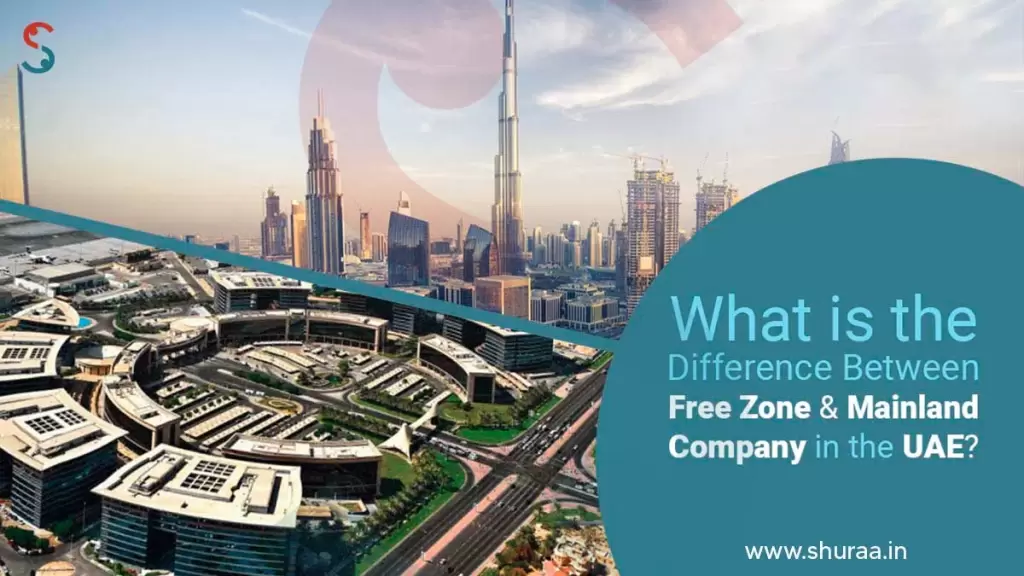
Dubai has become synonymous with business and entrepreneurship. As a city known for its rapid development and business-friendly environment, Dubai offers various options for setting up a company in Dubai. The two main choices for entrepreneurs are the Dubai Mainland and Dubai Free Zones.
Dubai Mainland is an economic zone monitored by the Dubai Department of Economy and Tourism (DET). Setting up a business in the Dubai mainland allows for greater flexibility in terms of business activities and the ability to trade within the local market. On the other hand, Dubai Free Zones are specialized economic zones that cater to specific industries such as technology, media, finance, and logistics. It offers a range of benefits to businesses, including 100% foreign ownership, tax exemptions, and customs-duty privileges.
Let’s understand the key differences between free zone vs mainland Dubai, the advantages and disadvantages of each option, and which one is right for you.
Dubai Mainland vs Free Zone Company Formation Cost — Full Comparison 2026
Cost is usually the first thing people ask about — and rightly so. But the honest answer is: it depends on your business activity, visa requirements, and the free zone or mainland authority you're registering with. What we can give you is a realistic ballpark so you're not caught off guard.| Cost Component | Free Zone (AED) | Mainland (AED) |
|---|---|---|
| Trade License Fee | AED 10,000 – 30,000 | AED 13,000 – 50,000 |
| Office / Flexi-desk | AED 5,000 – 15,000 / yr | AED 10,000 – 80,000 / yr |
| Visa (per person) | AED 3,000 – 5,000 | AED 4,000 – 6,000 |
| Registration / Admin | AED 2,000 – 5,000 | AED 3,000 – 8,000 |
| Estimated First Year Total | AED 20,000 – 55,000 | AED 30,000 – 1,44,000 |
Note: These are approximate figures for 2026. Costs vary based on the free zone authority, business activity, number of visas, and office type. For a precise quote tailored to your business, speak to a Shuraa India consultant who can map out the exact costs for your setup.
Planning your Dubai company budget? Get a free cost breakdown customised for your business — Request a Free Quote from Shuraa India →
What is the Dubai Mainland?
Dubai Mainland refers to the part of Dubai governed directly by the Dubai Department of Economy and Tourism (DET). A mainland company can operate anywhere in the UAE — no restrictions on geography, no limits on who you can sell to, and no additional approvals needed to access the local market.
For years, mainland company formation required a UAE national partner holding 51% of the business. That rule has now been largely scrapped. Most business activities today allow 100% foreign ownership on the mainland — a major shift that has made it significantly more attractive to international investors.
Mainland companies are also the only option if you want to bid on UAE government contracts — something free zone businesses are not eligible for.
What Is a Dubai Free Zone?
Dubai Free Zones are designated economic areas that operate under their own regulatory authorities, separate from the DET. There are over 40 free zones in Dubai, each focused on a specific industry or sector. Setting up in a free zone means you're governed by that zone's rules — and in most cases, you benefit from significant tax and customs advantages.
Some of the most popular free zones include:- IFZA (International Free Zone Authority) — widely chosen for its competitive pricing and flexible setup options
- JAFZA (Jebel Ali Free Zone) — ideal for manufacturing, logistics, and large-scale trading
- DIFC (Dubai International Financial Centre) — the region's top hub for financial services and fintech
- Dubai Internet City (DIC) — preferred by tech startups and established software companies
- Dubai Media City (DMC) — home to media houses, PR agencies, and content studios
Each free zone has its own permitted activity list, visa quota, and infrastructure. Choosing the right one matters — if you need help shortlisting, Shuraa India's team can guide you through the options based on your industry and budget.
Free Zone vs. Mainland: Explained
Here's a quick snapshot of how the two options stack up across the factors that matter most:| Factor | Free Zone | Mainland |
|---|---|---|
| Ownership | 100% Foreign Ownership | 100% Foreign Ownership (most activities) |
| UAE Market Access | Restricted – needs extra license | Unlimited – trade freely across the UAE |
| Corporate Tax | 0% (within free zone) | 0% up to AED 375,000 / 9% above |
| Setup Cost | Lower – starts ~AED 12,000 | Higher – starts ~AED 20,000+ |
| Office Requirement | Flexi-desk allowed | Physical office mandatory |
| Visa Eligibility | Based on the license package | More visa quotas available |
| Govt. Contracts | Not eligible | Fully eligible |
| Customs Duty | Exempt from the free zone | Standard UAE duty applies |
| Banking | Slightly harder to open an account | Easier with the DET license |
| Best For | Export, IT, media, consulting | Local trading, retail, services |
Key Differences — Explained in Detail
1. Ownership
Free zones have always offered 100% foreign ownership — that was their biggest draw for years. But with UAE's 2021 company law reforms, mainland businesses now also permit full foreign ownership for the vast majority of activities. The distinction has narrowed considerably, though a few specific sectors like oil & gas and some professional activities may still need local involvement. Always verify based on your specific business activity.
2. Market Access
This is the biggest practical difference. A mainland company can sell directly to anyone in the UAE — consumers, corporates, government bodies — without restrictions. A free zone company, on the other hand, technically operates outside the UAE customs territory. Selling to the mainland is allowed, but typically requires either a local distributor, an additional mainland trade license, or paying applicable customs duties.
If your business is primarily export-oriented or international, this won't bother you. But if you're serving local UAE customers directly, the mainland gives you far more freedom.
3. Taxation
UAE introduced a 9% corporate tax in June 2023. Here's how it applies:
- Mainland businesses: 0% on taxable income up to AED 375,000 (~USD 102,000). 9% on income above that threshold.
- Free zone businesses: Can maintain 0% tax on qualifying income, provided they meet the substance requirements of their free zone authority and don't derive income from mainland UAE activities.
Free zones still offer a tax edge — but only if your business genuinely qualifies. Mixing mainland activity into a free zone setup can remove that benefit entirely.
4. Setup and Running Costs
Free zones are generally cheaper to start. Flexi-desks are accepted, licensing fees are lower, and many zones offer all-in packages. Mainland requires a physical office with an attested lease agreement, which pushes costs up — especially in prime Dubai locations.
That said, the mainland gives you more operational leverage long-term: more visa quotas, the ability to open branches freely, and no restrictions on hiring.
5. Visas and Hiring
Both options provide UAE residence visas. Free zones allocate visas based on your license package — a flexi-desk might come with 2–3 visas, while a dedicated office allows more. Mainland companies generally get more generous visa quotas relative to office size and face fewer complications when hiring UAE nationals.
Not sure which option fits your headcount and hiring plans? Talk to us — Get Expert Advice from Shuraa India.
How to Set Up a Free Zone Company in Dubai
The process is relatively lean compared to the mainland:- Choose the free zone that matches your business activity and budget
- Check that your specific activity is on the permitted list for that zone
- Apply for initial approval with the free zone authority
- Submit documents (passport copies, business plan, application forms) and pay the fees
- Receive your trade license
- Open a corporate bank account
- Apply for employee visas if needed
- Set up your workspace and begin operations
How to Set Up a Mainland Company in Dubai
Mainland setup involves the DET and a few more steps:- Select your business activity from the DET's approved list and choose a legal structure (LLC, Sole Proprietorship, Branch, etc.)
- Reserve your trade name through the DET
- Submit your application with the required documents and pay the registration fee
- Secure a physical office and get the lease agreement attested by Ejari
- Collect your trade license from DET
- Open a business bank account
- Apply for staff visas and Emirates IDs
Both processes are manageable, but they involve coordination with multiple government departments. Working with a business setup consultancy like Shuraa India can cut the timeline significantly and help you avoid rejection due to documentation errors.
Free Zone or Mainland — Which One Should You Choose?
Choosing between a Dubai Free Zone and the Mainland for your business depends on several factors, and there's no one-size-fits-all answer. It's always a good idea to get an expert consultation from a leading business setup consultant in Dubai such as Shuraa India.
However, here are some key factors to consider:Choose a Dubai Free Zone if:
- Your business is primarily export-focused or you serve international clients
- You're in a specialised sector like tech, media, finance, or logistics
- You want lower startup costs and minimal office requirements
- You want to reinvest profits without paying tax (and meet the qualifying conditions)
- You don't plan on doing significant business inside the UAE mainland
Choose Dubai Mainland if:
- You're targeting local UAE customers — retail, food, real estate, services
- You want to bid on government tenders and public sector contracts
- You need a larger visa quota or plan to hire UAE nationals
- You want to open multiple branches across the UAE freely
- You prefer the flexibility of operating from any commercial location in Dubai
Ready to Set Up Your Dubai Company? Let's Talk.
Deciding between the Dubai Free Zone and the Mainland for your business depends on your specific needs and goals. Both options have their own advantages and disadvantages, so it's important to carefully consider your priorities before making a decision.
Seeking professional advice from experts like Shuraa India can be incredibly valuable during this process. We have the knowledge and experience to guide you in the right direction to ensure that you make an informed choice that aligns with your business objectives.
With our comprehensive services, from company registration and licensing to PRO services and visa assistance, we'll assist you every step of the way. Contact Shuraa India today!
Frequently Asked Questions
1. Can a free zone company do business in the Dubai mainland?
Yes, but with conditions. A free zone company can sell to the mainland UAE through a local distributor or agent. Alternatively, it can get an additional mainland trade license or pay customs duties on goods entering the mainland market. This is why businesses that primarily serve local UAE clients often find a mainland setup more practical.
2. Is Dubai a free zone 100% tax-free?
Free zone companies can qualify for 0% corporate tax on their income — but only on income that qualifies under the UAE's corporate tax rules. If a free zone company earns significant income from mainland UAE business, that income may become taxable. Always consult a tax adviser for clarity on your specific situation.
3. Do I need a local sponsor for Dubai Mainland in 2026?
For most business activities, no. The UAE government removed the mandatory local sponsor requirement for the majority of sectors in 2021. A small number of activities — primarily in specific professional categories — may still have restrictions. Your business setup consultant can confirm this for your activity.
4. Which is cheaper — free zone or mainland Dubai?
Free zone setup costs are generally lower. Packages can start around AED 12,000–15,000 for basic licenses with flexi-desks. Mainland costs are higher due to the mandatory office lease and DET fees. However, the mainland offers more operational scope which can make it a better value long-term for businesses targeting the local market.
5. How long does it take to set up a company in Dubai?
Free zone company formation can be completed in as little as 3–7 working days once all documents are in order. Mainland registration typically takes 1–3 weeks, depending on activity approvals and document processing. Working with a professional consultant speeds things up considerably.