Table of Contents
A Bengaluru-based startup founder recently shared something interesting during a startup networking event in Dubai. His startup grew significantly within one year after launch. His client base included people from the UAE, Europe, and Southeast Asia. Payments were arriving in USD, and expansion opportunities were opening up across global markets.
So, he started exploring a location for his business expansion plans. When he researched which country would help in maximising his profits through tax savings and a better client base, two names came to the top of his list. These two names were Dubai and Singapore.
And honestly, this is exactly where many Indian entrepreneurs find themselves today. A few years ago, international business expansion was something only large corporations thought about. Now, even early-stage founders, agencies, SaaS startups, e-commerce brands, consultants, and digital businesses are comparing global business hubs before scaling.
Choosing between Dubai and Singapore as your next business destination can appear difficult. Both attract founders from across the world. Both offer strong business environments. But the better choice depends entirely on what kind of startup you are building and how you want to scale it.
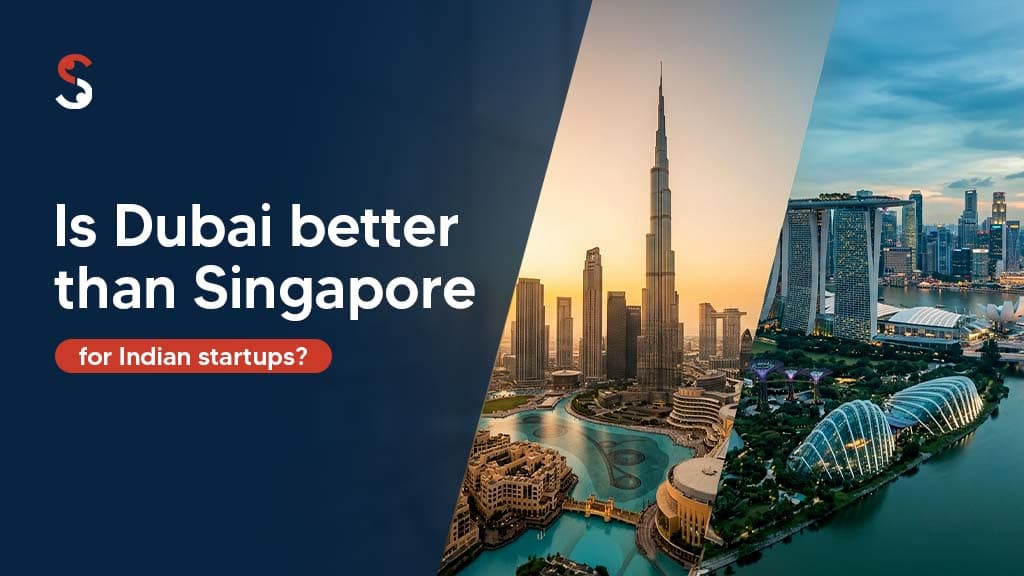
In this blog, we will break down the complete Dubai vs Singapore business setup comparison for Indian startups in 2026.
Before diving into details, here’s a quick overview of how both destinations compare for Indian entrepreneurs.
| Factor | Dubai | Singapore |
| Business Setup Time | Fast | Fast |
| Corporate Tax | 9% (0% in many free zone cases) | 17% with exemptions |
| Personal Income Tax | 0% | Progressive tax rates |
| Foreign Ownership | 100% ownership available | 100% ownership available |
| Market Access | Middle East, Africa, Europe | Asia-Pacific (APAC) |
| Ease of Setup | Very flexible and founder-friendly | More compliance-oriented |
| Investor Ecosystem | Growing rapidly | Highly mature |
| Best For | Trading, consulting, e-commerce, logistics, agencies | SaaS, fintech, AI, VC-backed startups |
| Operational Costs | Moderate | Higher |
| Lifestyle for Indian Founders | Familiar and highly connected to India | Structured and premium |
Both destinations are highly business-friendly. The difference lies in what your startup prioritises more i.e., operational flexibility or long-term institutional positioning.
Over the last few years, Indian startups have become far more global in their thinking. Indian entrepreneurs are no longer limiting themselves to one market. Modern startups often work with international clients, remote teams, global payment systems, and overseas investors from day one.
Because of this, founders are now looking for jurisdictions that offer:
Dubai and Singapore have become two of the most preferred options because both offer strong infrastructure, international connectivity, and startup-friendly environments.
Dubai has become extremely attractive for founders who want faster setup, lower taxes, easier residency options, and direct access to the Middle East and Africa. Singapore, on the other hand, continues to attract startups looking for strong investor credibility, advanced financial systems, and deeper access to Southeast Asian markets.
This is why the startup in Dubai vs Singapore debate has become much bigger in 2026 than ever before.
When founders decide to expand internationally, one of the first concerns is how quickly and smoothly the company can actually be established. In this area, both Dubai and Singapore perform very well compared to most global jurisdictions. However, Dubai often feels more flexible and founder-friendly for Indian entrepreneurs, especially during the early stages.
Dubai has become one of the easiest places in the world to start a business. The process is fast, digital, and designed to attract foreign entrepreneurs. Indian founders can choose between Mainland company setup, Free zone company setup, and Offshore structures.
Free zones are especially popular among startups because they offer:
Many startups in consulting, e-commerce, digital marketing, IT services, trading, and logistics prefer Dubai free zones because setup can often be completed within a few days.
Another major advantage is that founders can also apply for UAE residency through their business setup. This makes it easier for founders to live in Dubai and operate globally.
Dubai’s business ecosystem is designed for speed. Founders usually spend less time dealing with paperwork and more time focusing on growth.
Popular UAE Free Zones for Startups:
Singapore also offers a fast and digital incorporation process. The country is known for its highly organised regulatory system and strong legal framework. However, the setup process can be slightly more structured for foreign entrepreneurs.
In many cases, foreign founders need:
Singapore works exceptionally well for startups planning long-term regional expansion across Asia-Pacific markets.
The ecosystem is especially strong for SaaS startups, Fintech companies, AI businesses, Venture capital-backed startups, and Deep tech ventures. While incorporation is efficient, operational compliance can feel more detailed compared to Dubai.
Tax is one of the biggest reasons founders compare these two destinations.
Here’s a simplified overview:
| Tax Factor | Dubai | Singapore |
| Personal Income Tax | 0% | Up to 22% |
| Corporate Tax | 9% | 17% |
| VAT/GST | 5% VAT | 9% GST |
| Capital Gains Tax | Generally favourable | No capital gains tax |
| Profit Repatriation | Allowed | Allowed |
For founders generating international revenue, Dubai’s tax environment can significantly improve cash flow efficiency.
However, Indian entrepreneurs should also remember that FEMA regulations, tax residency rules, DTAA provisions, and RBI compliance still matter when operating internationally.
Many startups rush into overseas incorporation without understanding tax residency and compliance requirements properly. Speaking with Shuraa India experts before expanding internationally can help avoid costly restructuring later.
Dubai is often more cost-efficient than Singapore for many early-stage businesses. Operational flexibility is one of the biggest reasons behind this.
Founders can choose from virtual office solutions, shared workspaces, flexible visa packages, and different free zone pricing options.
That said, Dubai is still a premium international business destination. Costs can increase depending on:
But overall, many startups find Dubai easier to manage financially during the growth stage.
Singapore is known for higher operational costs. Businesses often spend more on:
However, many founders see this as a tradeoff for stability, strong infrastructure, and investor confidence. For funded startups targeting global markets, the higher costs are often considered part of building a premium international presence.
Dubai’s startup ecosystem has grown rapidly over the last few years. The UAE government has invested heavily in:
Dubai is becoming increasingly attractive for startups in Fintech, Web3, E-commerce, Logistics, Real Estate Tech, and AI services. The city is also attracting global founders because of its business-friendly policies and international connectivity.
For many Indian entrepreneurs, Dubai offers a practical combination of growth opportunities, tax efficiency, and global expansion potential.
Singapore remains one of Asia’s strongest hubs for venture capital and startup funding. The country has built deep investor confidence over decades.
Many international investors prefer Singapore structures because of strong corporate governance, legal transparency, IP protection, and financial system stability.
This makes Singapore particularly attractive for startups planning:
For startups heavily dependent on venture capital, Singapore often has an edge in fundraising maturity.
Dubai sits between Asia, Europe, and Africa, making it a major international business gateway.
Startups operating from Dubai can easily serve:
This is especially valuable for businesses in trading, logistics, export-import, consulting, and international services. For Indian entrepreneurs, the UAE also offers geographical proximity and easier travel connectivity.
Singapore is often used as a regional headquarters for Asia-Pacific operations. It offers excellent access to:
Many global technology companies use Singapore as their APAC headquarters because of its regulatory stability and advanced financial infrastructure. This makes Singapore highly attractive for startups planning deep expansion into Southeast Asia.
Lifestyle may not seem like a business factor initially, but for founders building long-term companies, it matters more than people expect.
Dubai has become highly attractive for Indian founders because of:
Many entrepreneurs also feel culturally comfortable in Dubai because of its large Indian population and familiar business ecosystem.
Singapore offers a different kind of appeal. It is known for:
Both cities offer high safety standards and world-class infrastructure. The right choice depends more on the lifestyle and expansion environment a founder personally prefers.
After comparing every major factor, the final answer depends on your startup goals.
Choose Dubai For –
Dubai works extremely well for founders in building profitable, globally operating businesses.
Choose Singapore For –
Singapore is often preferred by startups focused heavily on venture-backed scaling.
Note:
Every startup has its own operational needs, and a single ecosystem doesn’t work for all. Some businesses prioritise profitability and operational ease. Others look for funding and institutional credibility.
Here’s where each destination usually performs better.
| Business Type | Better Fit |
| E-commerce Business | Dubai |
| Trading & Export Companies | Dubai |
| Consulting & Agencies | Dubai |
| Logistics & Supply Chain | Dubai |
| SaaS Startup | Singapore |
| AI & Deep Tech | Singapore |
| VC-Funded Startup | Singapore |
| MENA Expansion Business | Dubai |
| APAC Expansion Business | Singapore |
| Freelancers & Solopreneurs | Dubai |
For many Indian SMEs and service-based startups, Dubai often becomes the more practical choice because of operational flexibility and easier international scaling.
Yes, and many growing businesses have already done this. Some startups operate with:
Hybrid structures are becoming increasingly common among globally scaling Indian startups. The right structure depends on your revenue model, founder residency, investor plans, client geography, and expansion goals.
Professional guidance becomes extremely important here because international structures must comply with Indian regulations, FEMA guidelines, and taxation rules.
The Dubai vs Singapore for startups debate does not have one universal answer. Both are world-class business destinations. Both offer major advantages. And both continue attracting ambitious Indian founders in 2026.
Singapore offers structure, investor confidence, and strong APAC positioning. Dubai offers speed, flexibility, tax efficiency, and global expansion advantages that are difficult to ignore.
Statistically, Dubai is more preferred launchpad for Indian founders because it combines international business access with founder-friendly operations. The UAE government’s focus on innovation, foreign investment, and entrepreneurship has made the country one of the most attractive destinations for modern startups.
If your goal is to build a globally connected business with operational flexibility and strong growth potential, Dubai offers a highly compelling environment to scale.
Choosing the right country is only the first step. The real challenge is choosing the right jurisdiction, license, business activity, and the right setup structure.
At Shuraa India, we help Indian entrepreneurs simplify the entire Dubai business setup process. From company formation, free zone setup, mainland licensing, visas, banking assistance, and compliance guidance, our team supports you throughout the process.
If you are planning to expand your startup internationally, this is the right time to explore how Dubai can support your business growth.
Get in touch with Shuraa India today and build your Dubai business with expert guidance.
Dubai is often considered better for Indian startups looking for faster setup, lower taxes, easier scalability, and access to Middle Eastern markets. Singapore is usually preferred by startups focused heavily on venture capital funding and APAC expansion.
In most cases, operational costs in Dubai are lower than in Singapore, especially for early-stage businesses and SMEs. Singapore generally has higher office, staffing, and living costs.
Yes, Dubai is becoming increasingly attractive for SaaS startups, especially those targeting MENA markets. However, startups seeking aggressive VC funding and APAC-focused expansion may also consider Singapore.
Yes. Many UAE free zones and mainland structures allow 100% foreign ownership for Indian entrepreneurs.
Dubai offers 0% personal income tax and competitive corporate tax rates, making it one of the most tax-friendly business destinations globally.
Singapore has a highly mature investor ecosystem and is often preferred for venture capital-backed startups, fintech businesses, and deep-tech companies.
Yes. Many startups use hybrid business structures depending on their operational, tax, fundraising, and market expansion goals.

About the author
Nityansh BhatiNityansh is a business content curator and UAE market advisor with expertise in company formation and corporate regulations in Dubai. He breaks down complex topics into clear and practical insights. His research-driven insights help entrepreneurs make confident and well-informed business decisions.
View all postsSpeak with Shuraa India for clear guidance on licensing, jurisdictions, visas, banking, and setup costs.